Asset Class
Each of us invests and uses our money in different ways. For this reason, there are various asset classes, all of which carry different opportunities and risks. Find out here which asset classes exist and why it makes sense to think about your own financial goals in this context.
What asset classes are there?
There is a wide variety of asset classes, so in the following we will limit ourselves to the four most important among them.
1. Equities
An equity is a security that certifies ownership shares in companies. When you buy a share, you therefore become a co-owner of the company. You thus benefit from positive business developments, for example through dividends.
Especially when viewed in the long term, equities are worthwhile as an asset class. Share prices on the market also automatically factor in inflation meaning equities offer good protection against inflation.
2. Bonds
A bond is a debt instrument created for the purpose of raising capital. So you are buying a claim against the debtor, who must repay this to you plus interest.
Bonds above all offer stable returns, as you as the investor continuously receive a fixed amount back.
3. Real Estate
Real estate as an asset class has certain similarities with equities and bonds. However, real estate has the advantage that it is less susceptible to price drops in falling markets, as rental income guarantees a regular stream of income. Thus, even in falling markets, the yield remains stable here.
4. Commodities
Commodities represent a broadly diversified asset class, as they cover energy commodities like oil or gas, industrial metals like aluminium, or even gold and silver.
Each individual commodity is driven by different factors which are independent both of each other and of other asset classes, such as equities or bonds.
Especially with regard to diversification commodities represent a particularly interesting asset class.
Correlation of the asset classes
The absolute best way to achieve the highest returns with the lowest risk is the so-called diversification.
In practice, diversification means that portfolios should be split across different asset classes and styles, countries, company sizes, and industries.
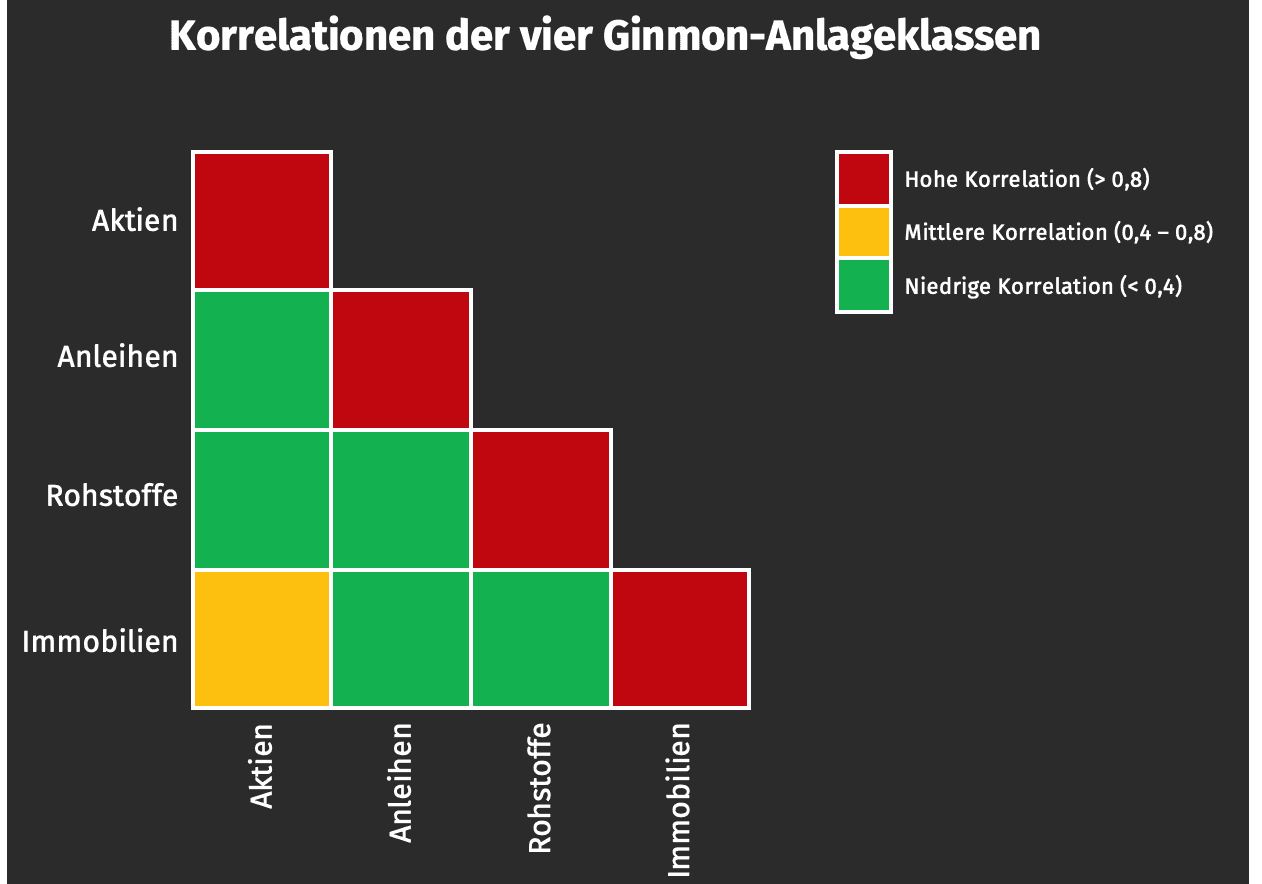
In the words of Nobel Prize winner Prof. Harry Markowitz, diversification is the only thing that an investor is actually given for free when investing. Due to the relatively low correlation between the four Ginmon asset classes, the risk of your investment is therefore significantly reduced.
How do I choose an asset class?
Each asset class has different characteristics. Some of them are designed for the long term, some are steady, others rather volatile. The ratio of opportunities and risks therefore differs across all asset classes.
In order to achieve the financial goals you are pursuing with your investment, it is above all important to become clear about your own preferences.
It is therefore important, on the one hand, to evaluate what risk you want to take in order to find out which asset classes are even eligible for you in the first place.
In addition, you should think about the structure of your investment, that is, how the asset classes should be composed.
Conclusion
Particularly important, with regard to the various asset classes, is to become aware of your own goals and risk preferences. This way, you can recognize and select the asset classes that are right for you.
With the right mix of asset classes, you can achieve your goals, regardless of whether stability, returns, or low risk is important to you. Ginmon offers you the opportunity of a broadly diversified portfolio that includes different asset classes.