Ginmon Annual Report 2021
At its start, the year 2021 was described as a "year of hope". New vaccines against COVID-19 were supposed to bring back some normality, a new US president was expected to bring stability to an unsettled world, and green participation in the German government was meant to bring about the climate transition. While some of these hopes were arguably disappointed, the capital markets were able to more than meet expectations. Over the course of the year, the major indices reached record high after record high, with the S&P 500 even managing a total of 70. True to the motto "even bad news is good news", the capital market had the right answer for every problem. In our annual report, we have taken a closer look at the most relevant topics from 2021.
Supply Chain Issues
Over the last few decades, we have taken it for granted that any demand, guided as if by an invisible hand, is immediately met with the right supply. In 2021, however, we had to learn that this invisible hand can only function if factories in Asia produce without restrictions and ships can distribute the goods all over the world. If these cogs do not mesh, you might well have to wait several months for a bicycle or a refrigerator. The cargo ship Ever Given, which got stuck in the Suez Canal, was just the tip of the iceberg here.
In a globalised world trimmed for "just-in-time" delivery, it is essential that the raw materials and intermediate products required for production are also in the right place at the right time. Covid-19 and the associated lockdowns put a spanner in the works of this system, because closed factories and anchored ships cannot provide the necessary replenishment. Germany imports goods worth over one trillion euros every year, making it particularly dependent on global supply chains, which has also made itself felt for retailers.
With these figures, the question naturally arises as to how the supply chains will develop in 2022 and whether there is already light at the end of the tunnel? Looking at the Baltic Dry Index, one can certainly be hopeful that the ordered bicycle will be ready for collection from your trusted dealer in the next few weeks. The index indicates the price trend for the shipping of raw materials. The sharp decline in prices over the last two months is an indication that the supply of shipping has increased again. This can therefore be seen as a positive indicator that it should become easier again to deliver goods from A to B in 2022.
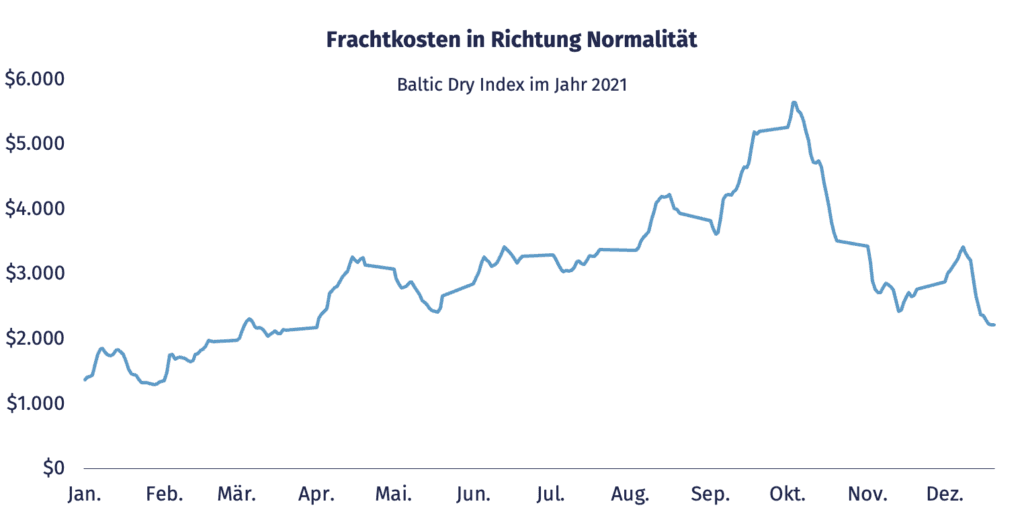
Source: Ginmon, Bloomberg, Baltic Dry Index: 10.01.2022
Inflation moves into focus
The year 2021 will also be remembered due to the return of inflation. While the past few years were mainly characterised by concerns about deflation, consumer prices in Europe and the US rose sharply last year. While the inflation rate in Germany stood at 5.3 percent in December, reaching a new 30-year high, prices in the US rose by 6.8%. This has triggered a debate about the reasons why inflation has risen so sharply and whether this will be permanent. Advocates of the ultra-loose monetary policy in particular argue that the inflation rate is due to special effects. These effects are mainly based on the fact that a year ago many prices fell sharply, supply became scarce due to supply chain problems, and raw material prices rose. In Germany, the VAT reduction in 2020 also plays a role. According to the European Central Bank, 3.4 percentage points of the rise in inflation were due to special effects.
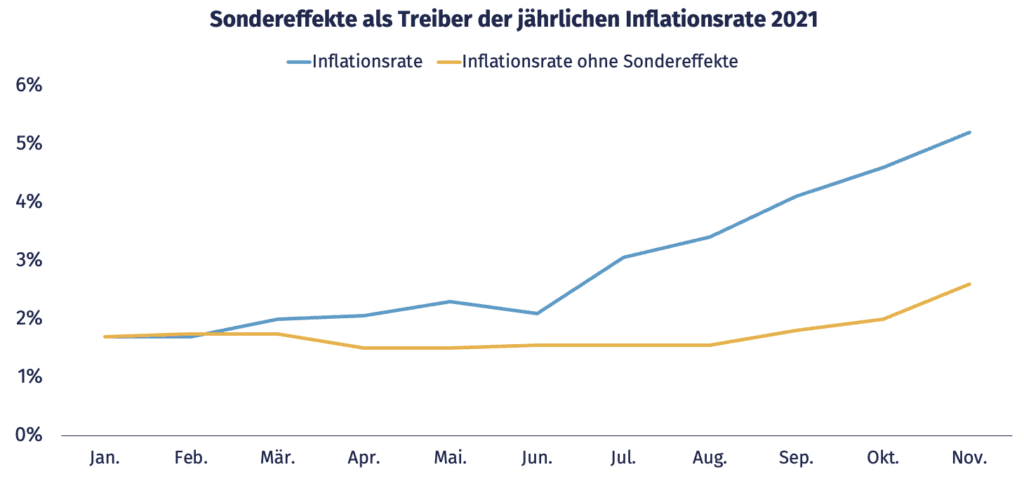
Source: Ginmon, European Central Bank: 10.01.2022
However, critics fear that there could be permanent inflation in the coming years. The crucial question now is to what extent the increased energy prices could also spread to other sectors and trigger a long-lasting wage-price spiral. However, the German Bundesbank and the leading economic research institutes in Germany do not assume that the high inflation rates will last long. For instance, all institutes are already forecasting inflation rates of around 2% for the year 2023, which would meet the ECB's target.
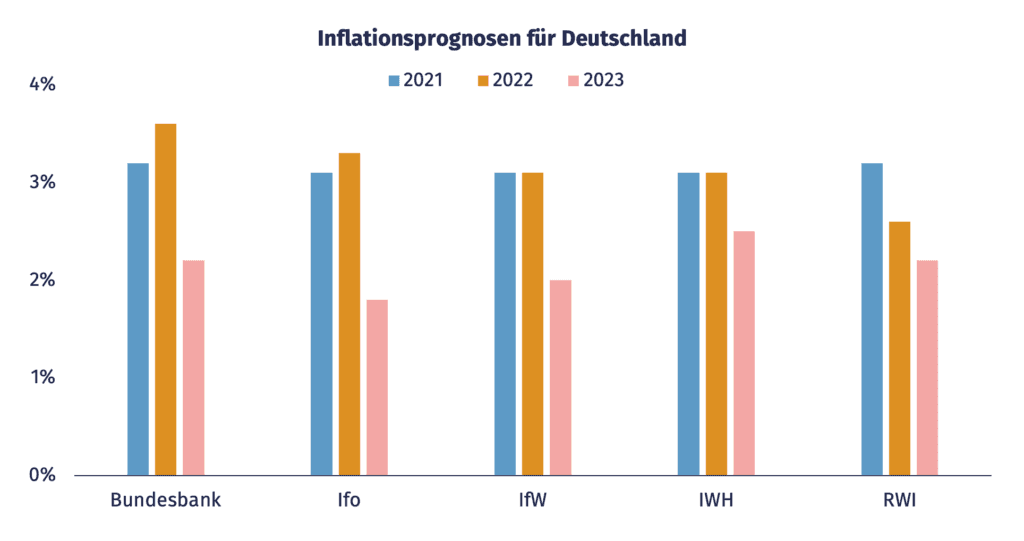
Source: Ginmon, Deutsche Bundesbank, Ifo Institute, IfW Kiel, IWH, RWI: 10.01.2022
China, regulation and a faltering real estate sector
China has risen both politically and economically to become one of the world's most important nations in the last decade. As a result, the international capital market reacts particularly sensitively to news from the Middle Kingdom. State President Xi Jinping has been pursuing a political agenda for some time in which the socialist idea of "common prosperity" has top priority. As inequality in China has risen sharply in recent years, the government is intervening more and more frequently in the economy. This tougher regulatory pace made itself felt particularly last year. Several sectors felt the impact of the increased regulatory approach pursued by Xi, be it the technology, education or real estate sector.
International investors reacted with uncertainty to the massive increase in state intervention. Investors were already startled in the summer by the profit ban imposed on online learning platforms. This incident reminded many investors that legal certainty and entrepreneurial freedom are defined differently in China than in the US or Europe. Under the guiding principle "housing is for living in, not for speculation", the real estate sector was also brought to heel. Stricter debt rules put the real estate group China Evergrande in trouble in 2021, which caused some moments of shock on the markets at the end of the year. After all, the Evergrande Group is not only China's second-largest property developer, but also the most indebted company in the world. Some market observers even feared the next Lehman Brothers. However, the catastrophe failed to materialise; at the end of 2021, Evergrande still exists and a global financial crisis has not occurred either. Why this was not to be expected either, we already explained in more detail in our market commentary in October.
Nonetheless, it is worth keeping an eye on the property market in China. According to expert estimates, the sector needs at least 197 billion dollars in January to be able to meet falling payment obligations. Falling prices of residential properties are also likely to weigh on commercial and private providers next year. It remains to be seen how the Chinese leadership will intervene here and whether they can stabilise the market again.
Performance of the Ginmon portfolios: A successful year
Looking at the news in 2021, one might come to the conclusion that the capital market must have suffered massively. But far from it – despite all the crises and tensions, the capital market has a successful year behind it. So how exactly did the Ginmon portfolios perform this year and where do we stand at the moment?
After a somewhat quieter third quarter, the fourth quarter profited once again from the year-end rally. The discovery of a new COVID-19 variant unsettled the markets only briefly and is now even seen as a beacon of hope due to a low mortality rate. Growing geopolitical tensions could not shake the markets either. Commodity prices and property prices continue to rise, which further drives inflation and is developing into a self-reinforcing process. In this market environment, all Ginmon portfolios, whether sustainable or conventional, were able to develop positively. The chart compares the four risk levels 1, 4, 7 and 10 of our two investment strategies. Our apeirongreen portfolio 10 showed the best return this quarter with an increase of approx. 5.8%.
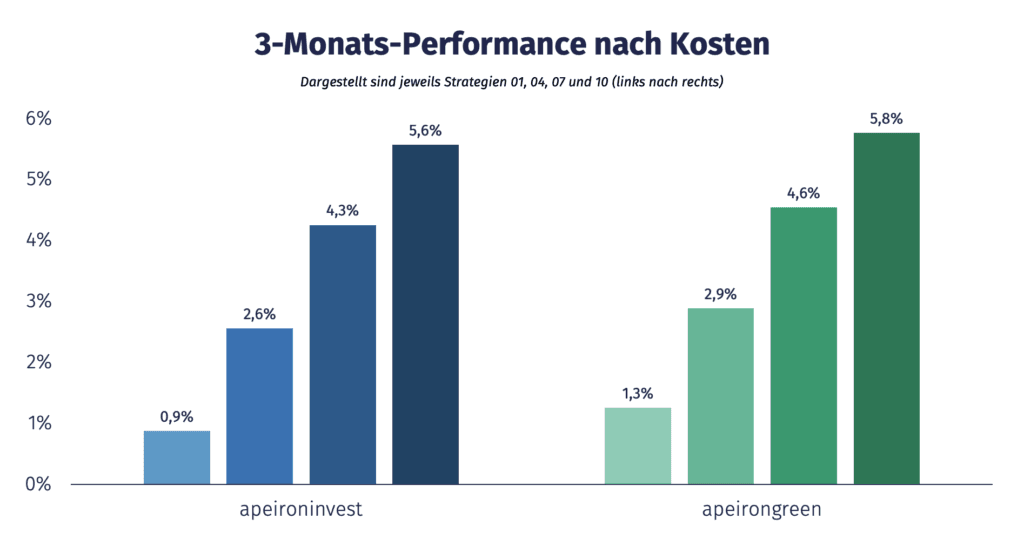
Source: Ginmon; as of 31.12.2021
At the end of the year, all strategies showed truly satisfying performances. Due to the strong development of the stock markets, the offensive strategies achieved above-average returns. At the same time, the conservative investments were also able to achieve very good returns.
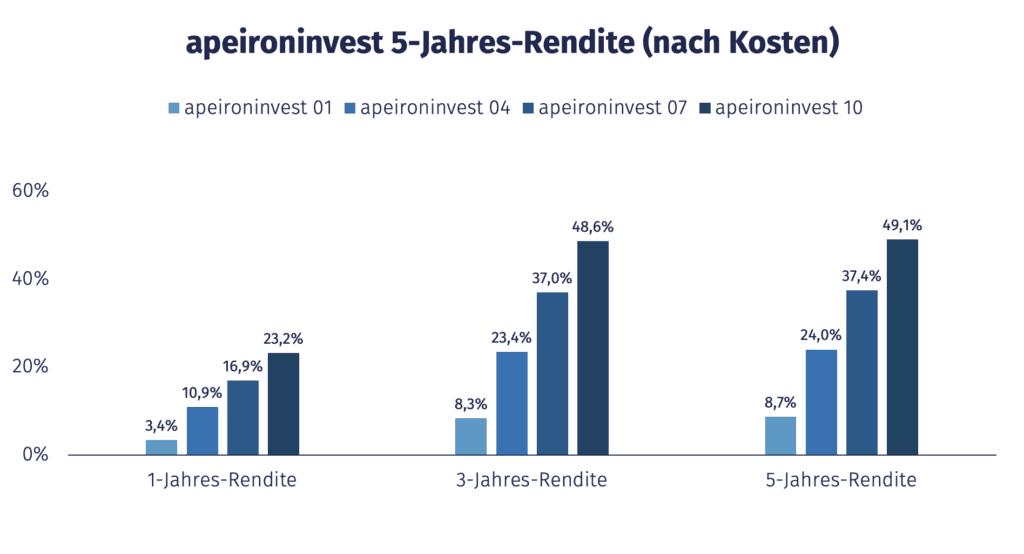
Looking at the returns over the past one, three and five years, a very positive picture also emerges. Our apeirongreen strategies will only celebrate their one-year anniversary at the end of the first quarter of 2022, which is why only apeironinvest is considered in the following figure. Customers who invested in apeironinvest 10 3 years ago were able to achieve an increase in value of almost 50%. It is also very pleasing that the low-risk strategies such as apeironinvest 1 developed very positively and thus represented a real hedge against inflation.
Source: Ginmon; as of 31.12.2021
Which drivers were responsible for the portfolio developments?
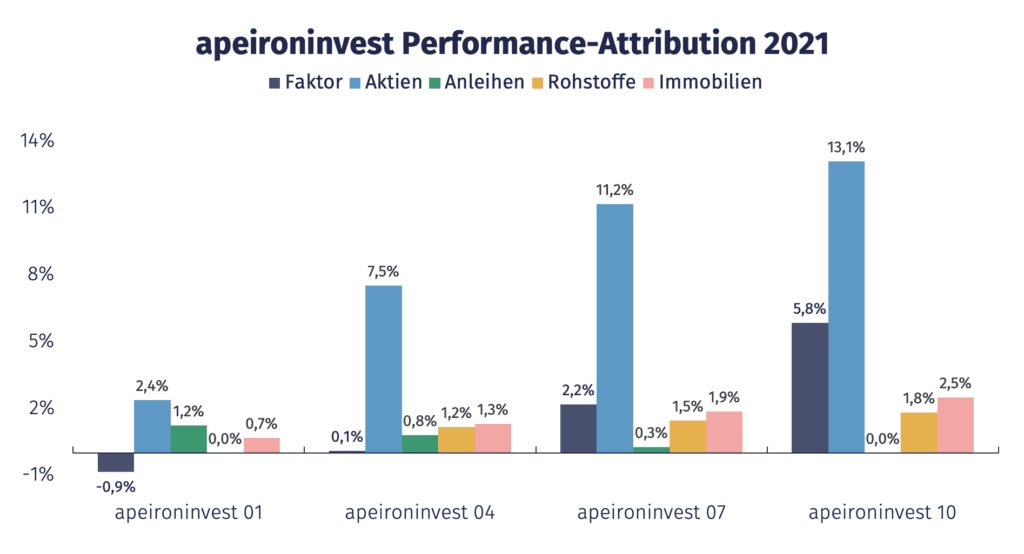
Throughout the entire year – unsurprisingly – equities were the strongest value drivers in the Ginmon portfolios. In addition, the classic invest strategies also benefited from developments in the raw material markets. Especially in the offensive strategies, factors were also able to make a very important contribution to returns. This again shows that targeted investment in smaller companies and value stocks is very attractive and offers the possibility of outperformance. Real estate was also able to fully play out its characteristics as inflation protection in the past year, contributing up to 2.5% to the portfolio return.
Source: Ginmon; as of 31.12.2021
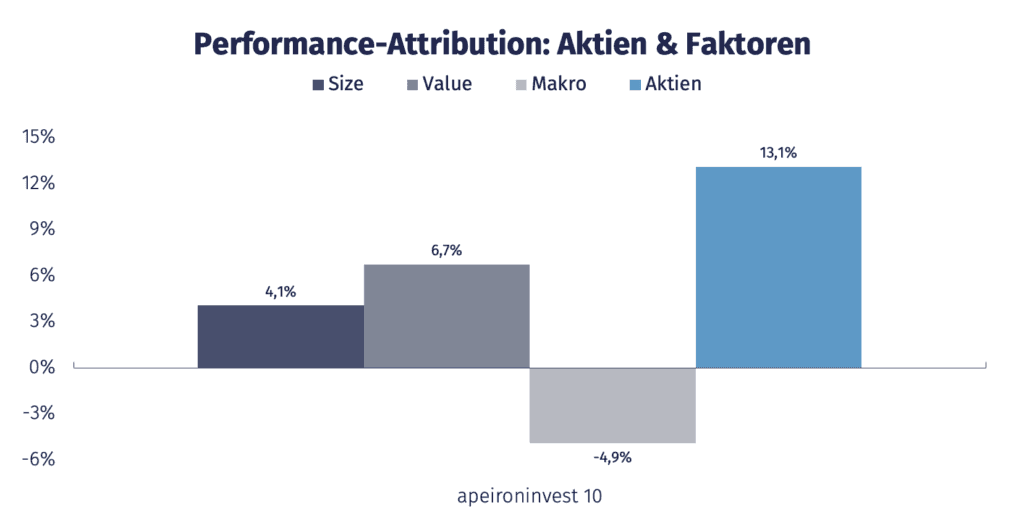
Let's take a closer look at the development of the factors for the year 2021. Here, it is noticeable that the macro factor stands out comparatively poorly. The explanation for this is quite simple, because Ginmon weights regions according to their share of global gross domestic product, whereas most benchmark indices such as the MSCI World weight by market capitalisation. In the end, this means that Ginmon uses a globally balanced approach, whereas weighting by market capitalisation leads to an overweighting of US equities. Weighting based on global gross domestic product results in Ginmon portfolios having a larger weight in emerging markets. These had to accept larger sell-offs in the past year.
Source: Ginmon; as of 31.12.2021
This is mainly due to the poor performance of the Chinese stock market. Stricter regulatory interventions, the potential collapse of Evergrande and growth worries scared off international investors, causing Hong Kong's Hang Seng Index to fall by over 14% in 2021. As a result, the macro factor is the weakest link among the equity components this year. Nevertheless, the Ginmon portfolios, which are significantly better diversified than the MSCI World, were also able to achieve a very high return without having to heavily overweight a single market.
Company Development
The year 2021 was extremely successful for Ginmon. This year, we reached two important milestones that make us very proud: for the first time, we manage more than 250 million euros from over 10,000 customers. With an average rating of 4.8 out of 5 stars, we are also the best-rated digital wealth manager in Germany. We are incredibly grateful to all our customers for the great trust shown this year.
In 2021, we also worked continuously on the further development of Ginmon and implemented many of the most frequently requested customer wishes. Just in time for the start of spring, we added sustainable investment strategies to our product range with apeirongreen. In doing so, we rely on the strictest sustainability approach on the German market, thus enabling our customers to actively and directly support ESG projects all over the world. In a year in which several asset managers and fund companies in Germany faced accusations of "greenwashing", it is all the more important to us not to make any compromises on sustainability.
Since the fourth quarter, we have also been offering our customers two new investment products: the VL-Konto (capital-forming benefits account) and the savings account. With the savings account, we now also offer an alternative to instant-access savings accounts or traditional savings books. The savings account combines the advantages of instant-access accounts, such as high security and high flexibility, with those of a capital market investment, such as a relatively attractive return. This is because, unlike instant-access and fixed-term deposits, it lies above the expected inflation rate of 2% in the medium term.
The VL account enables Ginmon clients to invest capital-forming benefits in a return-oriented manner on the capital market. Unlike comparable products, our VL account pursues a very return-oriented strategy. In the long term, a return of up to 6.7% p.a. after costs can be expected. Another advantage of the Ginmon VL account is that the invested amount does not have to wait for a lock-up period of seven years before being paid out, as is the case with other providers.
In addition to the product range, we have also expanded our services this year. Already at the beginning of the year, free and non-binding portfolio checks were added to Ginmon's range of services. This gives clients and non-clients the opportunity to obtain a transparent and professional analysis of their externally managed portfolios starting from €50,000. As an additional and frequently requested function, we have also introduced deposits via portfolio transfer. If clients want to use holdings from external portfolios to top up their investment amount at Ginmon, this is now possible digitally and paperlessly.
Die Inhalte dieses Artikels stellen keine Anlageberatung oder Aufforderung zum Kauf oder Verkauf von Finanzinstrumenten dar. Dieser Artikel ersetzt keine Rechts- oder Steuerberatung und dient ausschließlich Diskussionszwecken. Die in diesem Artikel vertretenen Meinungen stellen die aktuelle Einschätzung von Ginmon dar, die sich ohne vorherige Ankündigung ändern kann. Ginmon übernimmt keine Garantie für die Richtigkeit und Vollständigkeit der dargestellten Informationen. Frühere Wertentwicklungen sind kein verlässlicher Indikator für künftige Wertentwicklungen. Geldanlagen am Kapitalmarkt sind mit Risiken verbunden. Bitte lesen Sie unseren Risikohinweis.