BaFin was only established in 2002 – was there a Black Monday before then?
In the financial world, "Black Monday" is commonly associated with 19 October 1987. On this day, a largely unexpected stock market crash occurred worldwide. On that particular day, US markets lost more than 20%. Almost a quarter of the market capitalisation, or 500 billion dollars, vanished into thin air in just six and a half hours. Two of the main factors contributing to the severity of the Black Monday crash were computerised trading and portfolio insurance trading strategies, which hedged stock market portfolios by short-selling futures contracts on the S&P 500 index.
What was the state of the economy in the years leading up to 1987?
The US economy was in a recovery phase in the early 1980s. Corporations were indulging in takeover fantasies, fueled by Washington's incentives for acquisitions. Investors eagerly jumped onto every new IPO, hoping for a repeat of Silicon Valley's first IPO sensation, Apple.
However, profits had long since stopped keeping pace with share prices. The gap between share prices and book values grew wider and wider.
In the years 1985/86, the economy began to slowly cool down, which was primarily noticeable through a decline in economic growth and inflation.
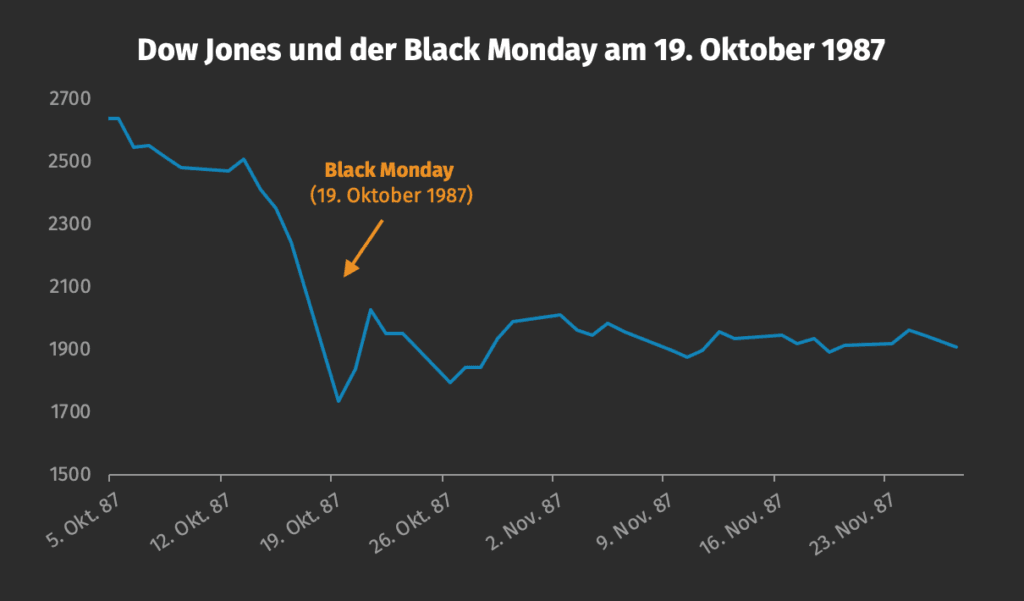
Nevertheless, the American index, the Dow Jones, recorded an impressive growth of 44% in the first eight months of 1987. As a result, the Dow Jones stood at a record high of 2,722 points.
How did Black Monday come about?
In fact, there was no single, clearly identifiable trigger for Black Monday. The crash came, so to speak, almost out of the blue.
To this day, it remains controversial which factors may have contributed to the sell-off.
A combination of a falling dollar, rising interest rates and, at the same time, a high trade deficit of 15.7 billion US dollars had already led to heavy selling in the stock market in the week before Black Monday.
With the opening of Asian stock markets after the weekend, the sell-off on the stock exchanges continued on Monday, 19 October 1987. This sell-off accelerated further after the opening of the London Stock Exchange.
The wave of selling got rolling – and took on a life of its own. Thus, investors had to witness the Dow Jones losing 22.61% within a single day, falling to 1738 points.
The newly introduced computer technology on Wall Street quickly came under suspicion in hindsight. It is speculated that banks placed too much trust in their automated selling programs, resulting in a lack of human supervision over these new automated processes.
How did the global economy develop in the years after 1987?
Following Black Monday, most central banks eased their monetary policy and thus helped the global economy to achieve renewed growth. A recession did not occur because of Black Monday.
The US economy was able to continue its growth cycle for three more years. The Dow Jones also reached its old all-time high of 2,722 points again in the spring of 1989, around 18 months after the largest single-day loss of all time.