BIP-Gewichtung
A key indicator of the strength of an economy is the gross domestic product. It reflects the total value of goods and services produced within a country in a year, and is used by all market participants as a central measure of the growth of a nation or region. Thus, GDP provides a fundamental look at the economic power of a country. What makes GDP weighting special and what advantages a portfolio allocation according to this method offers can be found below.
The Buffett Indicator
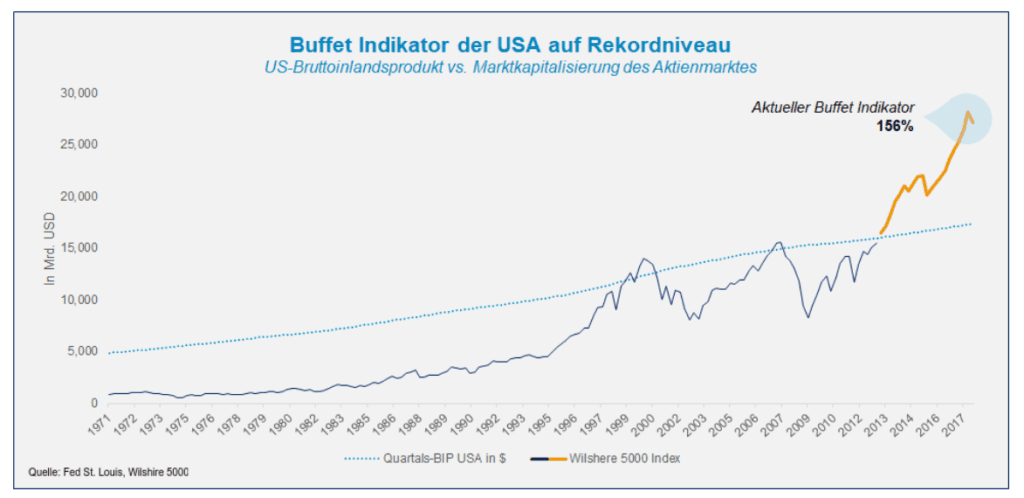
Comparing gross domestic product with the respective market capitalisation yields an approximate value between the valuation of the stock market and the actual output of an economy — the so-called Buffett Indicator.
This was developed by investment legend Warren Buffett and described by him as "probably the best single measure of where valuations stand at any given moment".
The metric can be used to assess whether stock market valuations actually reflect the economic output generated.
Basically, the higher the value of the Buffett Indicator, the more expensive the stock market is compared to a nation's overall economic output, and the more likely the stock market is to be overvalued.
A look at the US Buffett Indicator shows that since 2013, market capitalisation has steadily moved away from American gross domestic product.
Currently, the value stands at a historic 156%. For comparison, the Buffett Indicator in Japan in 1989 — just before the crash — was 145%.
The Advantages of GDP Weighting
GDP weighting is based on fundamental data — and is therefore emotionless and objective. The three-factor model by Nobel laureate Prof. Eugene Fama and Prof. Kenneth French, which forms the core of our investment philosophy, emphasises the importance of fundamental weighting.
Another important factor is that GDP weighting leaves aside emotionally driven developments in the stock market.
Furthermore, GDP weighting takes into account all enterprises in an economy, not just listed corporations.
This proves to be particularly advantageous in Germany, for example, because many companies there — unlike in the US — shy away from going public and are often still family-owned.
Companies like Bosch, Aldi, the Schwarz Group (Lidl), Würth or Bertelsmann are among Germany's largest firms, but none of them are listed on the stock exchange. Thus, they do not contribute to the market capitalisation of the Federal Republic.
Weighting based on GDP has the advantage that the actual relevance of the German economy is much better taken into account.
Furthermore, growth markets such as China and India, whose capital markets are still less developed compared to their economic output, are given greater consideration by GDP weighting.
This makes portfolios even more balanced and less dependent on individual markets, which also contributes to improved performance.
Conclusion
GDP weighting can be summarised in three words:
fundamental,
emotionless,
and balanced.
Since GDP weighting is based on fundamental data, emotionally driven developments in the stock market are not taken into account.
Furthermore, this weighting method includes all companies in an economy, which takes the real relevance of the German economy much better into account.
Last but not least, growth markets are also included here — which contributes to improved performance.
For this reason, the country weighting of our portfolios is calculated based on the respective national economic output.