Quarterly Report Q1/2018: How the portfolios started the new year
The first quarter of 2018 started turbulently, to say the least. Right at the beginning, stock markets were initially able to continue the growth trend of 2017. Both the DAX and the S&P 500 recorded new highs almost daily in January, until the spectacular 'flash crash' of 5 February put a temporary end to the bull market and ushered in a period of increased price volatility.
4 mins zum Lesen
Summary
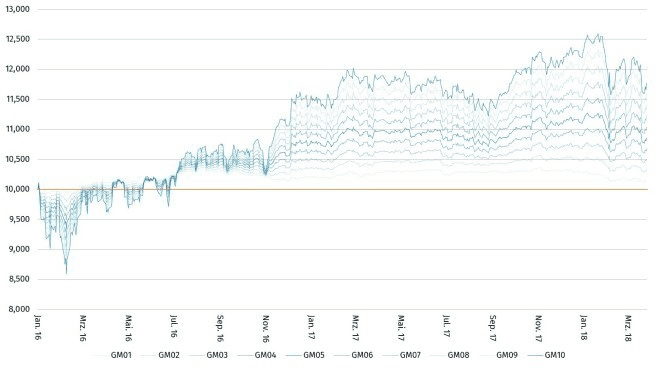
The positive trend from 2017 initially continued in early 2018, before the "flash crash" of 5 February fueled investor anxiety. A phase of higher volatility followed, from which the Ginmon portfolios were not immune, resulting in a performance of between -1.2% and -3.6% before costs in the first quarter.
Due to the anti-cyclical investment approach and investing in small and low-valued companies, our portfolios outperformed the MSCI, which ended the quarter with a return of -4.1%. The DAX also closed the quarter with a negative performance of -6.8%, after reaching a new record high of 13,559 points as recently as January.
President Trump's protectionist measures ("trade war") caused further unrest in the capital markets in the second half of the quarter, which continues to this day.
Capital market development in the first quarter of 2018: Volatility returns
First of all, the most important finding: after a nearly two-year phase of historically low equity market fluctuations, volatility has returned to the markets since 5 February. The spectacular "flash crash" attracted a great deal of media attention and also reached those who do not otherwise deal with capital markets. A look at the "Chicago Board Options Exchange Volatility Index", the so-called VIX or colloquially better known as the "fear index", confirms this. This index expresses the predicted future fluctuation of the American stock index S&P 500 over the next 30 days as a percentage and thus reflects the expectations of financial market experts regarding the anticipated volatility of stock prices.
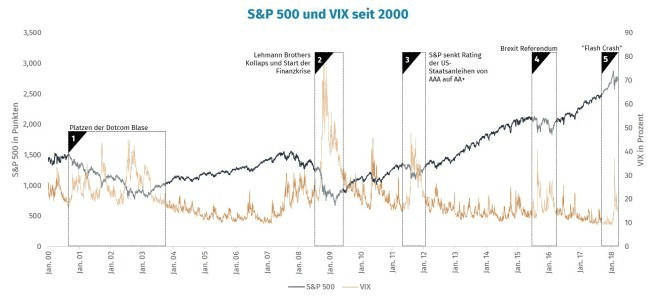
After the volatility barometer reached a historic low of 9.1% in mid-January, the "flash crash" in early February led to a surge in the index to over 37%, signaling growing uncertainty among market participants.
Ironically, the sudden rise in volatility and the associated brief drop in stock prices were caused by positive labor market data from the US. A solid increase in wage growth and a sharp drop in the unemployment rate fueled existing fears of inflation and the associated worries of a faster base rate hike by the US Federal Reserve. Numerous investors then closed their positions and stock prices collapsed abruptly. However, the subsequent labor market report revised the strong wage growth to just 2.6% instead of the original 2.9%. Consequently, the American stock index gained more than 2.0% from its low in early February to the end of the quarter. The Ginmon portfolios were also able to recover quickly from this temporary setback: for example, Investment Strategy 9 has already achieved a return of 1.6% after costs since the beginning of February.
Towards the end of the first quarter, the growing fear among capital market actors of an emerging trade war between the US and China led to renewed uncertainty. Following the US government's announcement to introduce punitive tariffs, the Chinese government responded on its part with increased trade barriers on US imports. However, the protectionist measures affect a relatively small share of the trade volume between the two nations and are therefore negligible for the broadly diversified Ginmon portfolios. The economic fundamentals do not point to a negative capital market outlook either: economic growth in the EU stabilized at around 2.0%, numerous American companies achieved positive quarterly results due to the special effects of the US corporate tax reform, and an agreement in the Brexit negotiations is within reach.
So stay invested: because those who sell in these psychologically driven market phases will regret it in the long term. Thanks to the attractive valuation of many asset classes, such phases offer optimal buying opportunities for rational investors.
Ginmon's anti-cyclical investment approach is particularly effective in such volatile market phases, as it benefits from the lower entry prices in fluctuating markets. Many investors have also taken the opportunity to top up their portfolios.
The Performance of Ginmon Portfolios
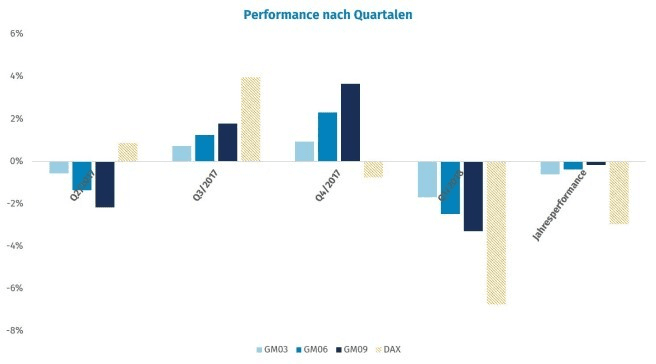
The price setbacks in the first quarter of 2018 were reflected in the performance of the Ginmon portfolios. For example, the return of our conservative Investment Strategy 3 was in negative territory for the first time since the middle of last year, at -1.8% after costs. Portfolios with a higher equity allocation were more heavily affected by short-term market fluctuations: the quarterly performance of Investment Strategy 9 fell by 3.4%, giving back the high gains achieved in the fourth quarter of 2017. On an annual basis, the Ginmon portfolios were also in negative return territory due to the negative performance in the first quarter of 2018 and the price setback in the second quarter of 2017. However, due to the anti-cyclical investment approach, our portfolios still achieved a significantly better annual return than the DAX, which lost more than 6.8% over the comparative period.
Company Development
In contrast to the developments in the stock markets, Ginmon's success story continued in 2018. Following the announcement of our international expansion, we were able to announce our cooperation partnership with the Stuttgart Stock Exchange just a few months later. Thanks to our cooperation with one of Europe's largest exchange operators, we can now offer our investment concept to an even broader range of clients. For its part, the Stuttgart Stock Exchange now offers its investors a professional solution for long-term wealth accumulation through this partnership.
Our Tech Team has also expanded its staff. At the beginning of the year, we were able to secure former Senior Cloud Architect Dmitriy Fot, who was previously with Amazon Web Services, as the new Chief Technology Officer for Ginmon. In addition to expanding the cloud infrastructure, Fot will drive the ongoing development of Ginmon's proprietary technology platform Apeiron.
Die Inhalte dieses Artikels stellen keine Anlageberatung oder Aufforderung zum Kauf oder Verkauf von Finanzinstrumenten dar. Dieser Artikel ersetzt keine Rechts- oder Steuerberatung und dient ausschließlich Diskussionszwecken. Die in diesem Artikel vertretenen Meinungen stellen die aktuelle Einschätzung von Ginmon dar, die sich ohne vorherige Ankündigung ändern kann. Ginmon übernimmt keine Garantie für die Richtigkeit und Vollständigkeit der dargestellten Informationen. Frühere Wertentwicklungen sind kein verlässlicher Indikator für künftige Wertentwicklungen. Geldanlagen am Kapitalmarkt sind mit Risiken verbunden. Bitte lesen Sie unseren Risikohinweis.