What is ESG investing?
The abbreviation ESG stands for Environmental, Social and Governance – and describes the three main criteria that are given particular attention in this investment approach. ESG investing can also be referred to as sustainable investing. In addition to positive returns, this investment approach focuses mainly on long-term positive impacts on society and the environment.
Why ESG investing?
Topics such as sustainability and climate change are becoming increasingly important and do not stop at the financial sector.
In order to react to emerging regulatory requirements and also the desire of investors for sustainable financial investments, more and more sustainable investment products have come onto the market, especially in recent years.
But what exactly characterizes these? What do you have to look out for? This article is intended to shed some light on the subject.
The abbreviation "ESG" is used both as a synonym for "sustainable financial investment" and as a concrete filtering criterion. ESG-compliant investing can fulfill two functions for investors: On the one hand, it represents the opportunity to let one's own values and beliefs flow into financial investing.
On the other hand, ESG criteria represent a sensible supplement in corporate analysis, in order to be able to identify companies that operate as sustainably as possible.
In this context, ESG factors can be viewed as additional characteristics of a company that reflect its developments and challenges.
Through them, investors are enabled to better evaluate chances and risks and make investment decisions based on a broader data basis. This approach is becoming increasingly important for many investors, particularly in the course of the ongoing climate crisis and growing awareness of one's own ecological actions.
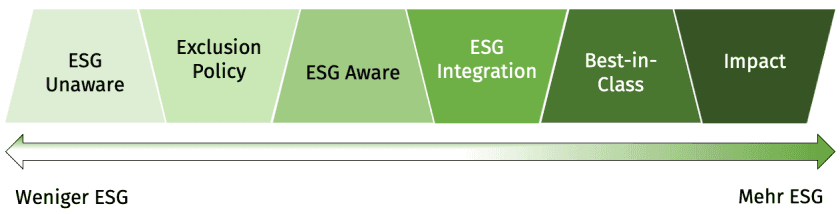
Different approaches exist regarding how this can be implemented. A key question here is how strictly the sustainability approach should be chosen. Fundamentally, investors find themselves confronted with a whole range of exclusion procedures for non-sustainable companies.
A comparatively generous approach is so-called "Exclusion Policies" (or negative screening). Here, companies are excluded solely based on coarse criteria such as their industry sector affiliation.
Classic sectors are, for example, the arms industry or tobacco producers. This approach only excludes a handful of companies and is therefore not complex but also cannot be rated as particularly sustainable.
Stricter approaches are, for example, more general ESG or SRI approaches up to specialized impact variants. It should also not be forgotten that an index can indeed consist of a combination of several filtering criteria, for example there are SRI products which additionally select companies based on their carbon emissions with a so-called "low-carbon" filter.
What are ESG risks?
Whether a company acts sustainably or not cannot be easily judged based on just a few criteria. In order to get a holistic picture of a company, an investor must delve deep into the matter.
The three ESG building blocks, Environmental, Social, and Governance, represent a common construct for analysis and offer initial starting points for further evaluations.
In this context, it has become increasingly clear in recent times that there are clear differences in the self-representation of companies and the actual facts.
E – Environmental
In the corporate context, environmental risks refer to business activities that can have real (negative) impacts on air, land, water, and ecosystems, among other things.
Human health is directly affected by these risks as a result. For this reason, it is absolutely necessary that the topic of the environment is considered when evaluating the sustainability of a company.
Among other things, companies must deal with the management of resources, the prevention and control of pollution, the reduction of emissions, the lessening of contributions to climate change, or even transparent reporting on sustainability aspects.
With a conscientious consideration and corresponding implementation of such principles, cost reductions and profitability increases through, for example, efficiency gains, the reduction of regulatory risks, and the avoidance of legal disputes and reputational risks are just a few examples of positive effects.
S – Social
Social risks relate, amongst other things, to the impacts that companies can have on society through their activities.
These risks are addressed through metrics that measure, for example, fair working practices, the promotion of employee health and safety, relations with suppliers, or also the diversity of the workforce and management.
In addition, maintaining human rights and focusing on product integrity also play a crucial role in this factor. The fact that the social factor can have direct impacts on society is shown by companies that stand out particularly positively here.
These companies are likely to exhibit higher productivity, better employee morale, and lower staff turnover. This factor can also have a direct influence on customers’ brand loyalty.
G – Governance
Risks in corporate governance concern areas such as diversity, executive compensation, board accountability, protection of shareholders' rights, as well as information reporting and disclosure.
Not least, this also includes anti-corruption measures and guidelines for dealing with whistleblowers. By implementing these factors, alignment of the interests of shareholders and management can be achieved.
Compliance with these principles can be linked by tying executive remuneration to the achievement of sustainability goals. Thus, misconduct can be punished directly, and investors remain (hopefully) spared from unexpected, unpleasant financial surprises.
Problems of ESG investing
Despite all existing difficulties, the topic of ESG and sustainability continues to gain ground in the global capital markets and is now estimated at a volume of 40.5 trillion US dollars.
In this context, it does not matter that the long-term financial performance of sustainable investments is disputed.
By using an ESG-compliant investment approach, the investable universe is already restricted significantly in an early phase of the investment decision. The possibility for diversification is thus limited and a certain cluster risk can arise.
At the same time, some ESG products on the market sometimes have higher costs than their traditional counterparts, which can be partly explained by the higher effort required for the applied filters.
On the other hand, there are also arguments that suggest that, through the application of ESG criteria, only companies that can develop long-term competitive advantages through their sustainability and transparency would be selected in an investment process.
This is even meant to minimize the corresponding risk.
However, before an investor even considers a sustainable investment opportunity, they should ask themselves whether the financial performance of a security should be the only selection criterion for sustainable investments, or if, in case of doubt, one would forego some yield to promote a good cause.
ESG investing on the rise
In the field of ESG investing, due to the relative novelty of this type of investing, there are hardly any legal or regulatory requirements.
As a result, there is also a lack of universally valid standards in the field of sustainable financial investments. Product providers thus have a comparatively large leeway to structure and title their investment solutions.
Due to the rapidly increasing awareness of the topic of sustainability and climate change among the population, the call for regulation is also growing.
In order to continue ensuring investor protection, extensive regulatory frameworks are being worked on all over the world. The EU in particular wants to take on a pioneering role here.
However, as there is currently no uniform legal framework established, it currently happens again and again, for example with ESG ratings, that the same company has a poor rating with one ESG rating provider while scoring very well with another provider.
These discrepancies can arise due to different levels of requirements or different areas of evaluation focus, thus contributing to the fact that the topic of sustainable financial investment is almost impossible for retail investors to see through.
In addition, the lack of legal guidelines repeatedly offers opportunities for companies to engage in so-called "greenwashing".
In simple terms, this means that, for example, a highly ecological philosophy is communicated to the outside world, whilst this is not consistently implemented within the company.
Investors and other parties can thus be disappointed and may find themselves confronted with risks they did not know about.
Sustainable investing at Ginmon

You will not find a more sustainable financial investment than that of Ginmon at any other digital asset manager. Based on the strictest criteria, only the sustainability pioneers of each asset class are considered.
Thus, for example, only particularly green companies, development bank bonds, sustainably mined gold, and sustainably certified real estate find entry into your portfolio at Ginmon