Dividend
The dividend is the share of the profit allocated to a share, which is usually distributed annually. With a dividend, investors in a joint-stock company therefore share in the profits. Such share purchases are particularly worthwhile in the long term, as they offer a higher yield than, for example, bonds. Find out here what a dividend yield is and what the level of the dividend says about the success of the company.
What is a dividend yield and how is it calculated?
The dividend yield is often compared to interest, as it indicates how much money investors receive in the end. But beware: not every company pays a dividend, as profits do not necessarily have to be distributed.
Tech companies in particular, such as Amazon, reinvest their profits back into their own company in order to grow faster.
The amount of your dividend depends on how much cash the company has in its coffers. Based on this figure, the management board of the public limited company makes a dividend proposal, which is voted on by the shareholders at the Annual General Meeting.
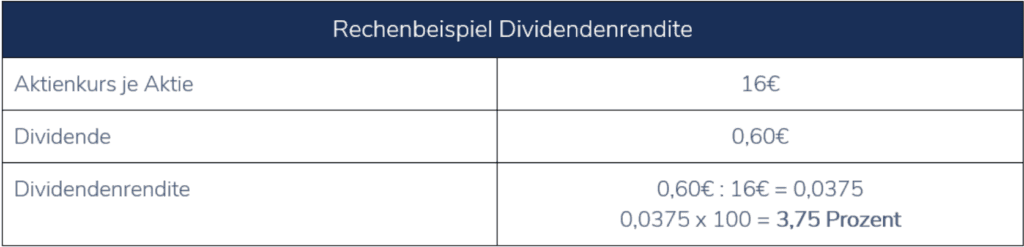
The dividend yield is then calculated based on the respective share price. Specifically, this means: the agreed dividend is divided by the current share price and then multiplied by 100.
For every euro you have invested in the company in the form of shares in this example, you receive a dividend yield of 3.57 cents.
A company's payout fluctuates over the years, depending on the financial success of the company.
What does the size of the dividend say about a company?
Dividends provide an indication for assessing the economic strength of a company. For this reason, dividends are sometimes distributed even if the company failed to make a profit from a business perspective in the past financial year.
In an ideal world, a company should measure its payout ratio by how much of the surplus cannot be used for investment or debt repayment.
Companies that have a high demand for investment, want to grow further or pay off debt, usually distribute small or no dividends at all, despite operating profits.
Companies that can no longer grow or only make minor investments can practically distribute their entire profit as a dividend.
These companies therefore often have comparatively high dividend yields, although they have not necessarily generated higher profits or are more profitable.
So it can also happen that the current dividend does not match the business success of a company.
This happens, for example, when events occur that eat up profits generated. In such cases, the dividend is often paid in full to keep shareholders satisfied.
Conclusion
The dividend yield indicates how much money investors ultimately receive. However, it must be noted that not every company pays a dividend.
The amount of the dividend generally depends on how much money is in the company's coffers. Although dividends provide a guide for assessing the economic strength of a company, you should not be fooled by them.
Even companies that have comparatively high dividend yields have not necessarily achieved higher profits or are more profitable in general.