China A-Aktien vs. H-Aktien
China is the world's second-largest stock market. However, due to strict regulation, a large part of the market is barely accessible to foreign investors. In the past, China was therefore completely excluded from global indices. Even today, the country remains heavily underrepresented in most indices.
What actually are A-shares?
Around 72% of the Chinese stock market consists of mainland shares, also known as A-shares, which were originally only purchasable by citizens of mainland China.
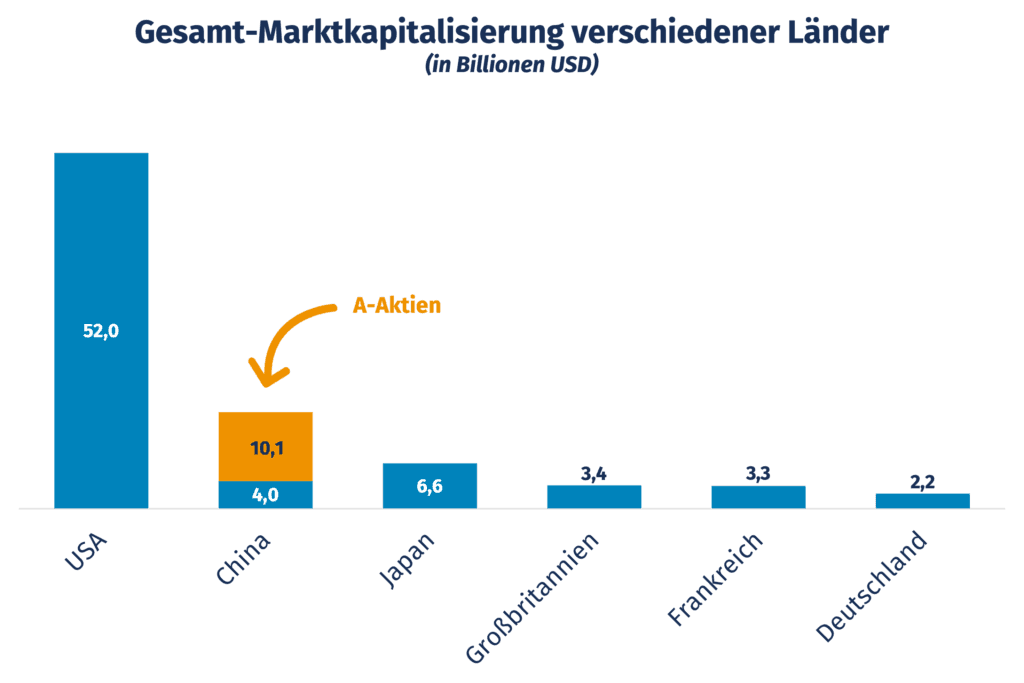
Source: S&P Global (as of January 2022)
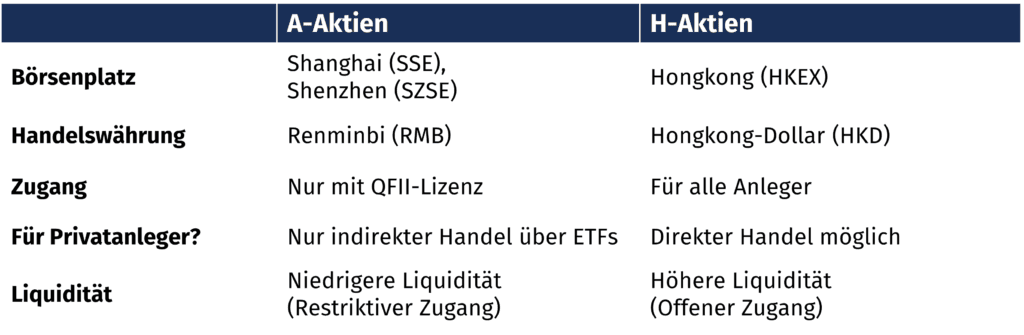
A-shares are listed on the stock exchanges in Shanghai (SSE) and Shenzhen (SZSE) and are traded in Chinese Renminbi (RMB). The restrictions on foreign investors were relaxed slightly in 2003, meaning that large international institutions have since been able to buy these shares as Qualified Foreign Institutional Investors (QFIIs).
Authorized investors receive licensing via the QFII program, which legitimizes them to buy and sell A-shares. This licensing takes place after an examination of the investor by the Chinese government or stock exchange supervisory authority. For this purpose, a number of requirements must be met, which the government uses to verify the financial stability and independence of the investor. In 2020, the number of foreign institutions licensed through the QFII was around 200, including major banks such as J.P. Morgan and UBS.
For foreign retail investors, access to A-shares remains extremely restrictive and participation in these companies is only possible indirectly. Since China in general, and A-shares in particular, are underrepresented in global indices such as the MSCI World or MSCI Emerging Markets, investing is often only possible via specialized ETFs.
The CSI 300 Index represents the 300 largest companies on the stock exchanges in Shanghai and Shenzhen. These are exclusively A-shares. An investment in this index is possible, for example, using synthetic replication via an ETF.
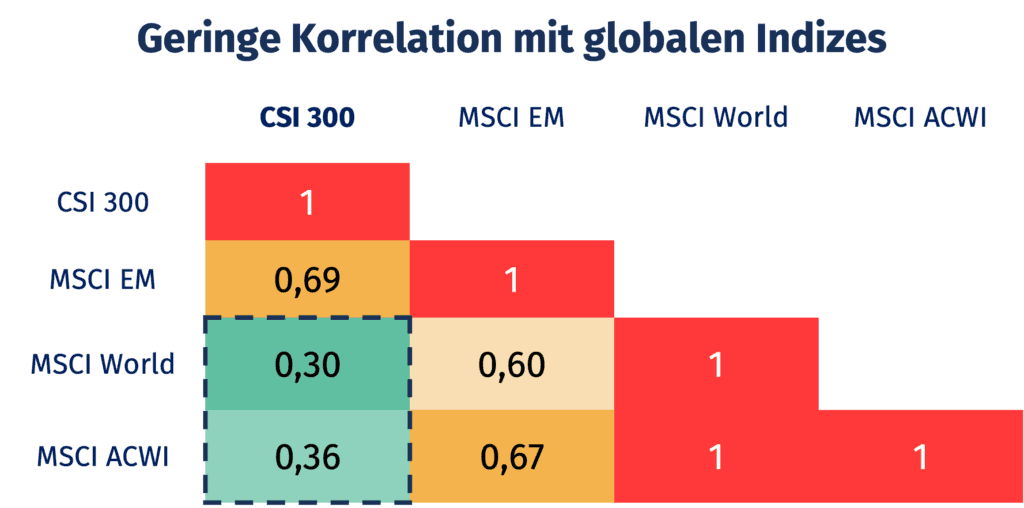
Source: Bloomberg, Aladdin BRS (as of 31/05/2022)
This is particularly interesting for investors who are specifically interested in the development of the Chinese economy. A large number of these companies – especially smaller ones – are only available as A-shares and are not listed on the Hong Kong Stock Exchange.
H-shares: The “open” part of the market
Unlike the exchanges in Shanghai and Shenzhen, the Hong Kong Stock Exchange (HKEX) is openly accessible to foreign investors. This is why primarily large Chinese (mainland) companies are (also) listed here in order to attract international investors. Examples of this include Alibaba, Tencent, and Chinese Ping An Insurance.
These shares of mainland Chinese companies listed in Hong Kong are referred to as H-shares and are traded in Hong Kong in Hong Kong Dollars (HKD). Due to regulatory restrictions, H-shares were not accessible to mainland Chinese citizens until 2007.
Since H-shares on the Hong Kong Stock Exchange are also open to international investors, they have significantly higher liquidity. Nevertheless, there is a strong price discrepancy in favor of A-shares. Often, the A-shares of a company trade at a premium on the Shanghai and Shenzhen exchanges compared to the H-shares of the same company in Hong Kong. Of the approximately 3,600 companies on the Shanghai and Shenzhen stock exchanges, 100 also have a secondary listing in Hong Kong. In the past, the premium between these shares was up to 60%, with a historical average of around 22% across all sectors.
Even so, this does not mean that A-shares are generally a better investment, because they are significantly more illiquid and are not investable for retail investors anyway, or only through indirect routes.
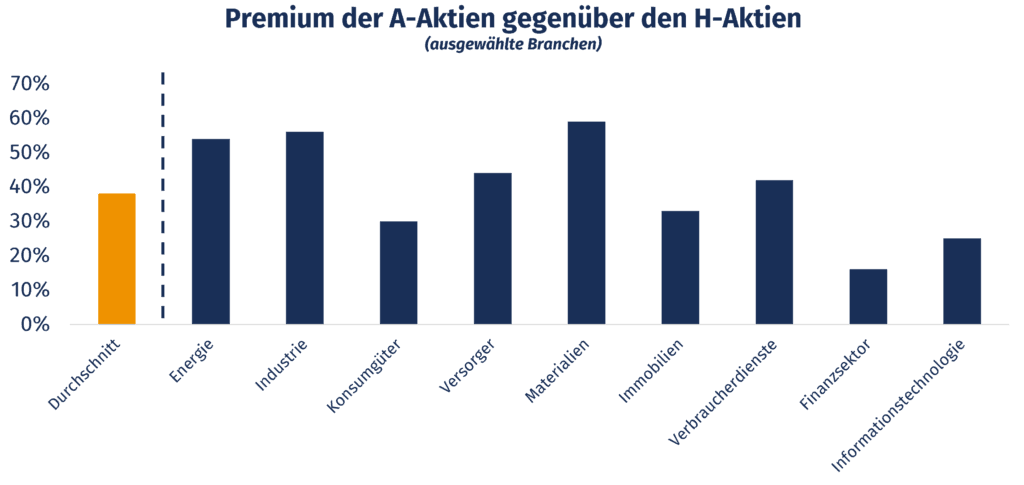
Source: “Analysis of Price Differences Between A and H Shares”, Y. Bai, W.M.Tang & K.F.C.You, 08 June 2019