bear market
On stock exchanges, there are always two opposing market movements: shares can either rise or fall. In times when the market is in a sustained downward trend and the prices of a broad index, such as the DAX, fall by 20% or more, this is known as a bear market. This scenario is particularly realistic during times of economic recession.
Where does the bear market association come from?
The term bear market comes from the animal kingdom and is derived from the behaviour of a bear. The bear is an animal that is naturally characterised by defensive behaviour. In dangerous situations, bears primarily make a run for it.
They prefer to flee before they attack. However, when bears do attack, for example when hunting, they often strike their prey by standing on their two hind paws and swiping from top to bottom.
In a figurative sense, this can also be applied to the course of prices in times of recession. The bear is considered pessimistic and bets on falling prices in its stock market actions.
Generally speaking, a bear market is when the prices of a broad index, such as the DAX, fall by 20% or more.
The counterpart associated with rising prices is the bull. Both dissimilar animals stand in front of the stock exchanges in New York, London and Frankfurt.
The Frankfurt sculpture was commissioned in 1985 by the Board of Directors of Deutsche Börse. Sculptor Rainer Dachlauer, who was born in Frankfurt, created the bull and bear artwork within three years.
What is a bear market rally?
Bear market rallies are periods during a bear market in which markets recover strongly within a very short space of time. However, this happens within the framework of an overarching downward movement, so further setbacks follow and the bear market continues. Whether a price recovery is a bear market rally or a fundamental trend reversal can only be determined with hindsight. The criterion used is whether or not the price recovery was able to overcome the long-term downward trend.
Historical bear markets in the US
There have been 11 major bear markets in the US since 1929. It took different lengths of time to reach the 20% loss threshold that defines a bear market.
While during the 2020 Corona crisis the leading American index, the S&P 500, had already lost more than 20% after 16 days, it took a whopping 310 days for the bear market that began in the winter of 1980.
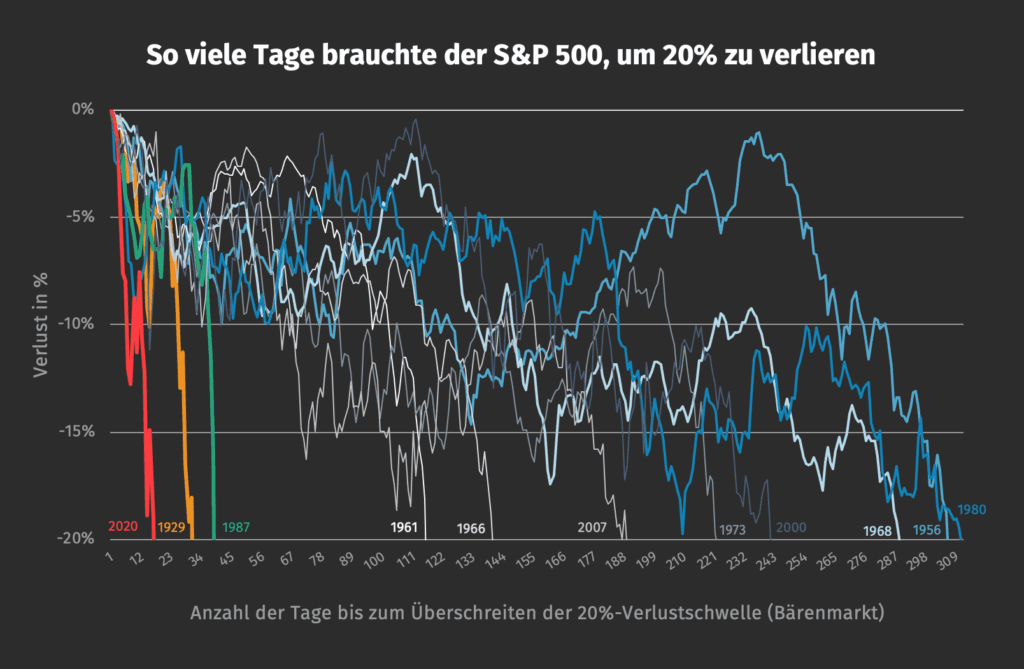
Bear markets occur regularly on global stock markets. The S&P 500, for example, recorded three bear markets in the 1960s alone (1961, 1966 and 1968).
What does a bear trap refer to?
A bear trap can open up when, after a phase of rising prices, stock markets start to correct and fall. In such phases, many investors take the falling prices as an indication that the market will fall even further and that a bear market is imminent.
If an investor panics and sells his shares in this expectation, he can lose a lot of money. This happens if no bear market occurs and prices rise again a short time later. The investor has fallen into the bear trap and reacted too hastily.