What is a bond rating
Bond ratings are representations of the creditworthiness of corporate or government bonds. The ratings are published by credit rating agencies and provide assessments of the financial strength and ability of a bond issuer to repay the bond's principal and interest in accordance with the contract. Rating systems classify bond investments by quality (investment grade / non-investment grade / not rated) and risk (from default to the highest quality). Investment-grade rated bonds are considered safe investments with minimal risk of default, but offer minimal yields. Non-investment grade bonds are riskier but typically offer a higher yield.
How does a bond rating work?
The procedure for creating a rating differs depending on the publisher of the rating. Essentially, it is about determining the creditworthiness and thus the suitability of a debtor to meet their financial obligations.
To this end, the financial situation of the bond emitter is analysed. The probability of default of the borrower is determined using statistical mathematical procedures. Afterwards, a credit rating is calculated from this.
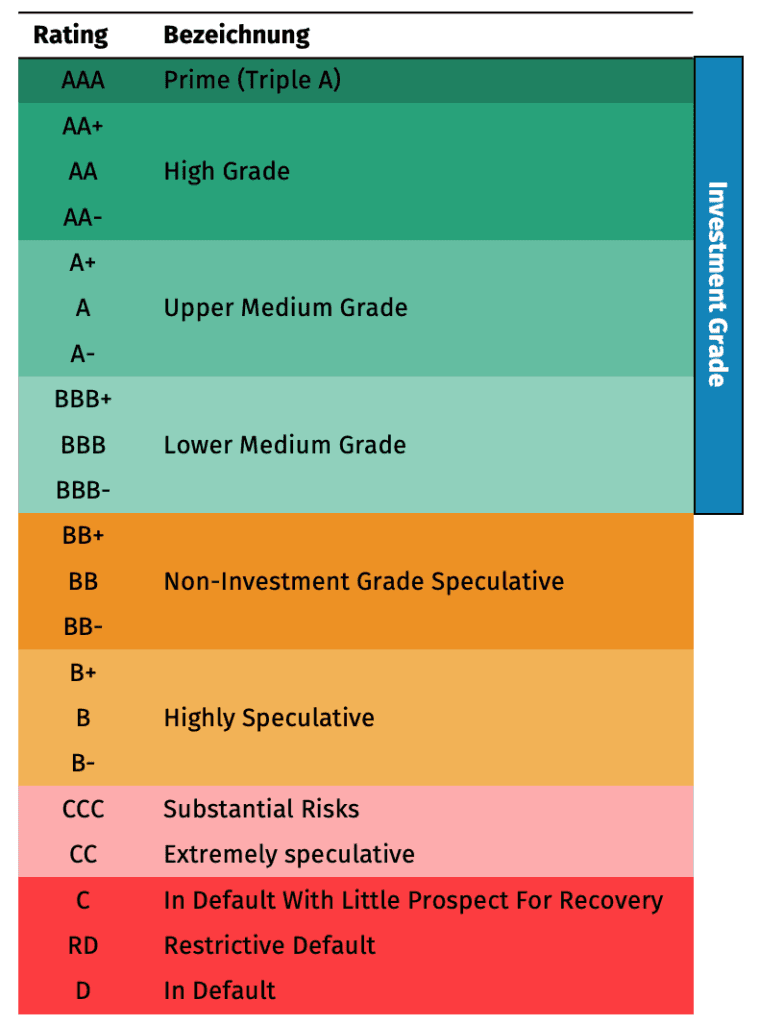
Rating scale from Standard & Poor's, as of 31/03/2020
The rating agencies themselves publish very few details about their rating processes. 97% of all ratings worldwide come from the four largest global rating agencies: Moody's, Standard & Poor's, Fitch and DBRS. These each have their own rating scales and letter codes.
At Standard & Poor's for example, the rating classes, also known as notches, range from AAA to D. AAA is the highest credit rating and is often called "Triple-A". Bonds with a D rating are insolvent.
In general, the higher the rating, the easier and cheaper it is for a borrower to obtain debt capital. Conversely, this means that a bond with a lower rating must offer a higher yield to compensate investors for the higher risk of default.
Investment Grade: The seal of approval
The "Investment Grade" seal of approval refers to the creditworthiness of the emitter and certifies that bonds are of investment-grade quality. For a bond to carry this title, it must have received at least a BBB rating according to the Standard & Poor's rating system or a Baa3 rating according to Moody's.
All bonds with a lower rating are assigned to the "Non-Investment Grade" category. This category is also often referred to as "High Yield". These "high-yield" bonds, also known as junk bonds, are speculative investments that offer a comparatively high yield, but at the same time carry a high risk of default.
Since many institutional investors, such as pension funds, are only allowed to invest in investment-grade bonds due to regulatory requirements, achieving this rating is particularly desirable for a bond or its emitter.
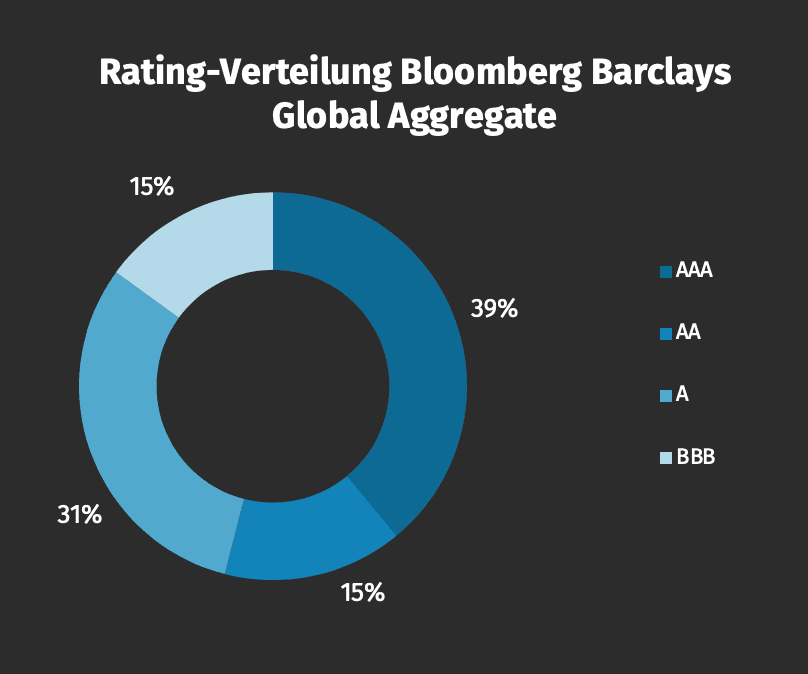
How common are which ratings?
The Bloomberg Barclays Global Aggregate Index is the world's largest index for investment-grade bonds and at the same time represents an important benchmark for investors. The index contains both government and corporate bonds. With over 21,000 individual securities, the index is representative of the entire investment-grade universe.
In the Bloomberg Barclays Global Aggregate Index, 39% of the bonds have the highest credit rating AAA. 15% of the bonds have the second-highest rating AA, followed by 31% with rating A. 15% of the bonds are to be found in the BBB rating category. BBB is the worst rating that is still classified as investment grade.
Figure on the right: Distribution of key index components of the Bloomberg Barclays Global Aggregate Index by rating; as of 31/03/2020
The loss of Investment Grade rating
It is common for a bond to lose its "Investment Grade" status after a re-evaluation. The reason for such a rating migration can be a general deterioration in economic conditions (e.g. recession), sector-specific changes, or financial problems on the part of the borrower.
Since the bond is now in the speculative area (Non-Investment Grade), there is often a sharp drop in price. This is not least due to the fact that many institutional investors are now obliged to sell off this bond.
In principle, bond ratings exist for all issuers of bonds. These can be companies, credit institutions, insurance companies, or indeed countries. While and business-related key figures are particularly relevant for companies, national ratings incorporate key economic indicators such as gross domestic product or investment volume, but also soft factors such as political stability into the analysis.
Currently, there are only nine countries in the world that hold the highest credit rating of AAA from all major rating agencies. In contrast to the three largest economies, the US, Japan, and China, Germany is represented in this elite club. The remaining eight countries with a Triple-A rating are Canada, Denmark, Liechtenstein, Luxembourg, the Netherlands, Sweden, Norway, Switzerland, and Singapore.