Ginmon Annual Report 2023
For the business world, 2023 was a year of spectacular highs, painful lows, and unexpected twists. Defying expectations that equities would fall and bonds would rise, the US Federal Reserve has seemingly achieved a rare soft landing so far. Equities soared, proving unstoppable despite two pullbacks driven by shifting interest rate expectations, as demonstrated by the performance of the S&P 500.
A Turbulent 2023: Spectacular Highs and Lows in the Economic World
Emerging markets experienced an outstanding year, and cryptocurrencies rose from the ashes despite several spectacular scandals. The combined net worth of the 500 richest people increased by 1.5 trillion dollars, fully recovering from the 1.4 trillion dollars lost in the previous year. And not to forget, this was the year when the AI star ChatGPT changed everything.
At the end of the year, the Federal Reserve signalled that it will probably not make any further interest rate hikes to curb inflation, pushing the markets to a year-high. One reason for this was a cooling labor market, characterised by reduced job growth.
On this basis, the S&P 500 neared a record, and the global bond market is on track to record its largest two-month gain ever. Traders are strengthening expectations that central banks globally will cut rates next year. Now that predictions of a US recession in 2023 (and the year before) have failed to materialise, attention is shifting beyond monetary policy to disruptions from events like attacks on commercial shipping in the Red Sea, corporate earnings, and the US presidential election.
Q1: Interest Rates Squeeze the Banking World
In the first quarter of 2023, the economic world was shaped by a series of momentous events. In the first week of the year, stock markets experienced a rally driven by strong employment figures and a low unemployment rate. Despite initial fears of a recession, economic growth showed resilience, and the US Federal Reserve slowed its interest rate hikes.
In the bond market, the surge in US Treasury yields attracted attention, with the 10-year yield exceeding 4.00% and the 2-year yield exceeding 5.00% for the first time since November.
In Florida, a political conflict ignited as Governor Ron DeSantis took control of the self-governing district of Walt Disney World, a move reflecting nationwide culture wars. International tensions escalated when the US shot down an alleged Chinese spy balloon, leading to the cancellation of a meeting with Chinese President Xi Jinping and further deteriorating relations.
The banking industry experienced dramatic developments when three US banks, including some with heavy crypto exposure, failed within a few days. This led to extraordinary emergency measures by regulatory authorities to stabilise the financial system. In an emergency deal, UBS acquired the struggling Credit Suisse for 3.25 billion dollars to prevent a further escalation of the financial crisis – a turbulent first quarter in business and politics.
In the technology sector, OpenAI, the developer of ChatGPT, received a significant investment from Microsoft. This highlighted the growing importance of Artificial Intelligence in 2023. Google responded to the challenge of ChatGPT by developing its own AI products.
Q2: Easing Inflation
In the second quarter of 2023, a series of important economic and technological developments dominated the scene. Apple strengthened its presence in India by opening its first Apple Stores in Mumbai and Delhi, highlighting the country's growing importance as a market and manufacturing location. At the same time, the US Consumer Price Index showed an easing of inflation, prompting the Federal Reserve to reconsider its interest rate hike strategy.
In the health sector, new weight-loss drugs caught attention, and the pharmaceutical companies involved, including Novo Nordisk and Eli Lilly, recorded significant share price gains.
The Biden administration responded to the challenges of Artificial Intelligence with a national AI strategy, helping Nvidia reach a market valuation of 1 trillion dollars. In the aviation industry, the FAA announced plans to integrate flying taxis into airspace, potentially ushering in a new era of mobility.
Politically important was the raising of the US debt ceiling to prevent a government default.
Apple introduced a new mixed-reality headset, which, however, was criticised as being too niche-specific due to its high price. The S&P 500 finally ended its longest bear-market phase since the 1940s, indicating an economic recovery.
Q3: US Downgraded
In the third quarter of 2023, the world experienced several notable events, ranging from Hollywood's first double-strike since 1960 to significant changes in the banking sector.
In another significant development, the credit rating of the US was downgraded by Fitch, an echo of previous political disputes over the country's growing debt burden.
In the energy market, crude oil recorded significant gains following production cuts by Saudi Arabia and other OPEC members as well as Russia. The successful IPO of Arm Holdings revived the IPO market, with further listings from companies like Instacart, Klaviyo, and Birkenstock.
Finally, America's national debt reached a record high of over 33 trillion dollars, presenting a major fiscal and economic challenge due to rose interest rates.
Q4: The Long-Awaited Rally
In the Middle East, a brutal attack by Hamas led to an escalation of tensions. This had repercussions on defence stocks and oil prices and led to the creation of a naval task force to protect commercial vessels in the Red Sea.
In the tech industry, Sam Altman returned to OpenAI as CEO after a brief move to Microsoft, accompanied by controversy.
Investors betted on the end of the Federal Reserve's rate hike cycle, which was reflected in stock markets. Energy prices continued to fall as the US pumped crude oil in record quantities, forcing OPEC members to make production cuts. The quarter was characterised by a multitude of events that has both global and industry-specific impacts, ending a rather turbulent year.
2024: Investors Shift Focus Beyond Monetary Policy
The year 2024 promises a wealth of elections around the world, which will significantly shape not only the political landscape but also the global economy. Roughly half of the world's population will head to the polls this year, and the consequences of these decisions are far-reaching. The world will be watching the outcomes of these elections with suspense, as they reach far beyond national borders and will shape the future of global politics and business. It remains to be seen how the elected governments will respond to the pressing challenges of our time and how the geopolitical landscape will evolve in the years to come.
After the US Federal Reserve signalled that it probably plans no further rate hikes to curb inflation, markets are increasingly focusing on risks beyond monetary policy. Driven by this, the economic outlook, corporate earnings, and the upcoming US presidential election in November are at the forefront of investors' minds.
A key challenge for investors in 2024 will be to assess the lagging effects of the Fed's rate-hike cycle. Wall Street strategists are divided on where stock markets are headed next year. Many were already wrong with their gloomy predictions in 2023, as, contrary to expectations, the S&P 500 jumped by more than 24% despite bank collapses, recession fears, and the highest borrowing costs in decades.
Five key themes are emerging for retail investors in 2024:
Central Bank Rate Cuts
In recent months, support for equities has been bolstered by growing speculation that the US Federal Reserve could start cutting borrowing costs from mid-2024. Markets are pricing in earlier and deeper rate cuts. Thus, swap traders are betting that the central bank will cut interest rates by about 150 basis points next year, twice as much as predicted by Fed officials.Growth of Big Tech Companies
The seven largest US tech companies, ranging from Nvidia Corp. to Microsoft Corp., were responsible for 64% of the S&P 500's rise in 2023, driven by the boom in Artificial Intelligence. This "Magnificent Seven", which also includes Amazon.com Inc., Apple Inc., Google parent Alphabet Inc., Meta Platforms Inc., and Tesla Inc., are projected to record earnings growth of 22% next year, twice as high as the S&P 500 average, according to data compiled by Bloomberg Intelligence. Crucial will be the extent to which these expectations are already priced into stock levels, particularly in view of increasing expectations for a soft economic landing.US Presidential Election
Historically, US equities tend to trend bullish in election years when the incumbent president is running. Since 1949, the S&P 500 has gained an average of nearly 13% in such election years, according to the Stock Trader’s Almanac. One reason for the gains in equities is that incumbents typically implement new policies or seek tax cuts to boost the economy and voter sentiment ahead of the election.Japan, India, and China
In Asia, there is a risk for the Japanese stock market in 2023, especially due to the policy of the Bank of Japan. Although the Nikkei 225 stock index reached a 30-year high, driven by the bank's ultra-loose monetary policy and a weak yen, Japanese equities face a challenge in early 2024. The central bank is holding on to the world's last negative interest rate, but two-thirds of economists predict it will conduct its first rate hike since 2007 by April 2024. After another disappointing year for investors betting on China, focus will be on the meetings of the National People's Congress and the third plenum for clues on Beijing's 2024 growth target and potential fiscal stimulus. India, on the other hand, is considered a great hope for investors. The country is securing high-profile manufacturing contracts, increasing infrastructure spending, and establishing itself as an alternative to China.European Central Bank Policy
With the Stoxx Europe 600 index near its highest level in two years, cyclical stocks heavily dependent on Asia could hold the key to further gains, particularly given potential fiscal stimulus from China. Although a weak economy is likely to dent European earnings growth, analysts expect estimated earnings growth of about 4% in 2024, largely driven by rising margins, according to Bloomberg Intelligence data. Bond markets expect the European Central Bank to cut rates by April, which could give the region's equities an extra boost. The Bank of England is expected to lag both the US Federal Reserve and the European Central Bank in easing monetary policy, given that the UK has one of the highest inflation rates among G7 nations.
How did these developments affect the Ginmon portfolios?
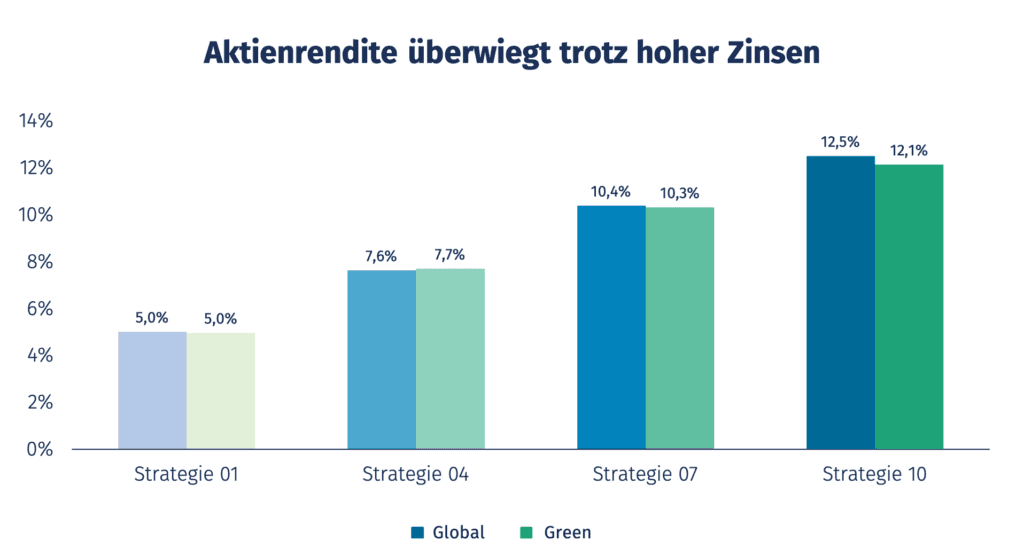
(Source: Ginmon; as of: 31/12/2023)
A. Portfolios in general
Over the course of 2023, the Ginmon portfolios generated considerable gains, driven by the dynamic performance of companies in developed markets. Outstanding was the impressive performance of stock markets in the United States and Europe, which delivered above-average returns compared to emerging markets. In a remarkable turnaround, previously lagging markets also participated actively in the positive market development. In particular, the upswing of asset classes that were once considered a drag on portfolios stood out, and which now reached the top of performance. A striking example of this is US small-cap stocks, which lagged behind other asset classes by nearly 5% up to the end of October. However, in the last two months of the year, they staged an impressive turnaround with a return of over 22%, advancing to become top performers.
The Ginmon portfolios benefited additionally from the integration of commodities and real estate, which contributed to diversification and significantly reduced volatility. Although commodities generated negative returns in 2023, this strategy led to improved risk spreading and more stable portfolio structures. This development was influenced, among other things, by rising interest rates, which dented demand for mortgage loans, as well as more efficient global supply chains that allowed cost savings in the production and delivery of various commodities.
As a result, the robustness and extraordinarily positive medium- to long-term development of the Ginmon portfolios become clear. In a comparison over the last three years, Ginmon Invest 10, for example, shows superior performance compared to the stock markets in Germany, Europe, and even the USA.

(Source: Ginmon, Degiro, Finanzfluss, Bloomberg; as of: 31/12/2023)
B. Return-oriented strategies
Within a relatively short time frame, an extensive market revival triggered significant increases in value across various asset classes. Over the course of 2023, large-cap corporations with extensive market capitalisation particularly distinguished themselves as leading market participants. Ginmon’s risk-willing investment strategies tend to favour value stocks with advantageous price-to-book ratios as well as exposure to smaller companies. Characteristics of 2023 were the expectation of potential interest rate cuts and mounting concerns about a potential banking crisis. In this scenario, growth stocks outperformed value stocks, while smaller banking institutions faced significant challenges.
In addition, 2023 revealed structural weaknesses in emerging markets, particularly for companies focused on sustainability, which were influenced by economic shifts in China. China continued to address the economic fallout of the strict lockdown measures of 2022, which left deep marks on the national economy.
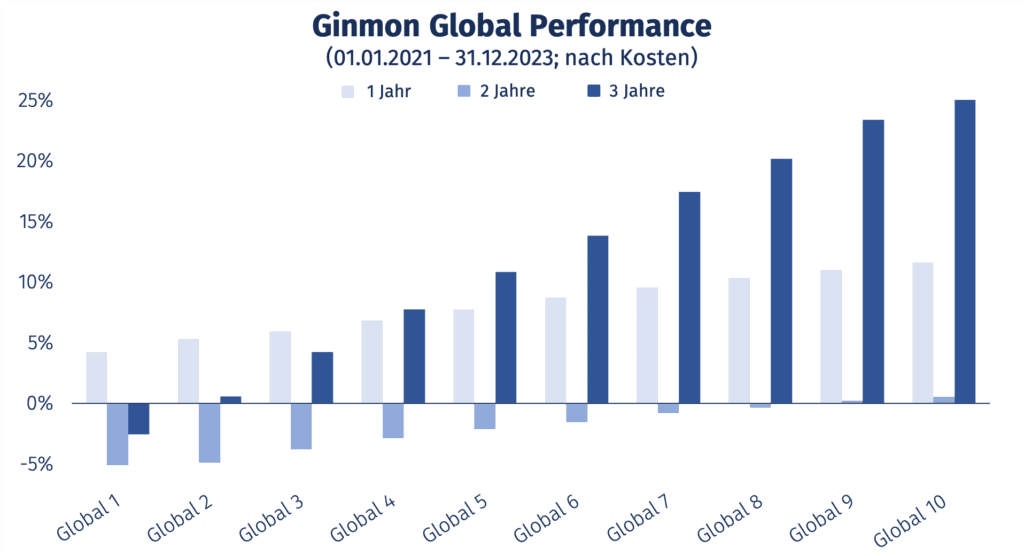
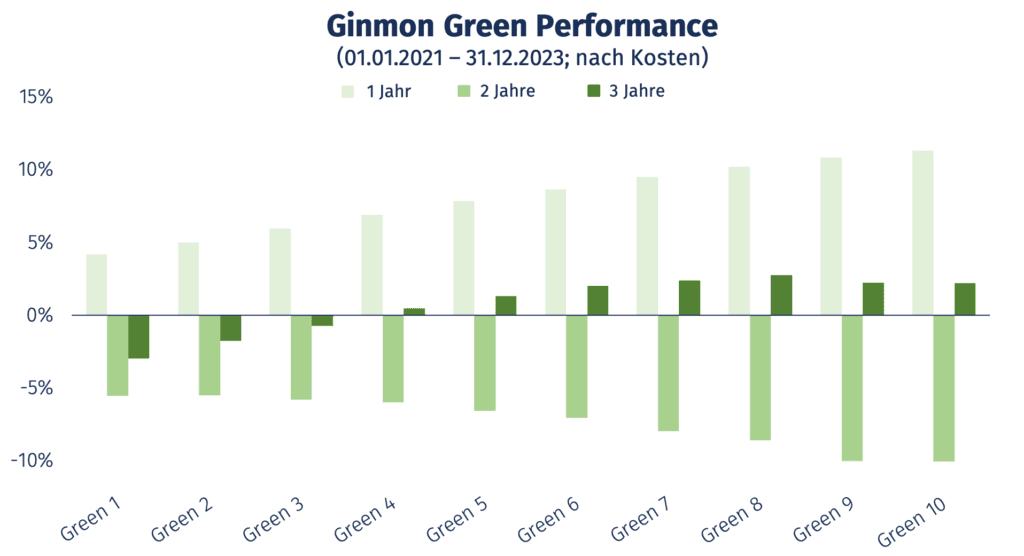
Although the Ginmon portfolios in the "Global" and "Green" strategies achieved positive results in 2023, fully realising the return potential of their investment strategies remains a goal to strive for. This presents attractive opportunities for contrarian investors.
C. Capital-preservation strategies
The accelerated hiking of policy rates by central banks exerted a tangible impact on conservatively oriented investment strategies, which manifested in a decline in bond prices. There is a prospect that such strategies could benefit from current interest rate movements in the future. This is supported by market price adjustments and reinvestment dynamics, as newly executed bond investments should benefit from increased interest rate levels in the medium term.
D. Interest offers
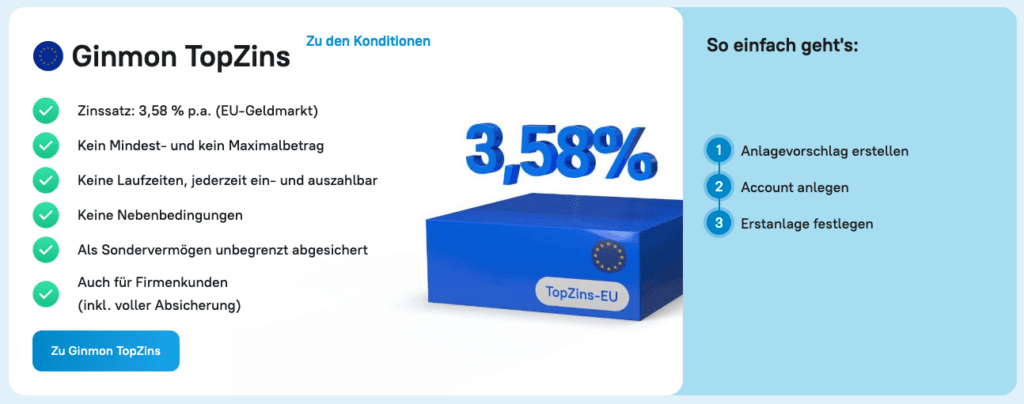
The investment product Ginmon TopZins, which has invested primarily in money market funds since May, has achieved notable returns of up to 3.58% p.a. thanks to the current high interest rate level, leading to continuous value growth.
Even though the current high interest rates look very tempting at first glance, the performance data from 2023 (see performance graphs for Ginmon Global and Green strategies) prove that every Ginmon Invest strategy has generated a higher return than pure interest products. For a medium- to long-term investment, it is therefore recommended to opt for Ginmon's investment strategies instead.
Developments at Ginmon
Over the course of 2023, we worked on a series of significant changes and improvements at Ginmon, paying particular attention to the optimization and adaptation of our savings account offering.
In May 2023, a fundamental realignment of the previous savings account took place, which is now based on money market funds and operates under the name Ginmon TopZins. This strategic redesign allows our clients to directly benefit from the current phase of high interest rates. Furthermore, the Ginmon TopZins account offers a risk-free alternative to our established investment strategies, especially the Global and Green strategies.
In addition, the product portfolio was expanded with the introduction of the Ginmon focus theme TopZins US, which is presented as one of a total of 18 thematic investment options. This innovation represents another step in our mission to offer a wide range of investment options tailored to the diverse needs and preferences of our clients. Through these additions, Ginmon strengthens its commitment to providing high-quality, customer-oriented financial products that are both profitable and safe.
(Source: Ginmon; as of: 14/01/2024)
Conclusion
The year 2023 was characterised by significant successes and challenges
Contrary to expectations, the stock market, especially the S&P 500, experienced an upswing despite fluctuations, just as emerging markets and cryptocurrencies also recorded a strong year. The Federal Reserve signalled no further rate hikes at the end of the year, bringing markets to a high. The labor market showed signs of cooling, and there is a prospect of rate cuts by central banks worldwide. Attention is now focusing on events beyond monetary policy, including geopolitical developments and the upcoming US presidential election.
The year 2024 will be shaped by global elections that will have significant political and economic ramifications. Financial markets are focusing on risks outside monetary policy, as the US Federal Reserve plans no further interest rate hikes. Investors are evaluating the aftermath of the Fed's rate hike cycle, while the S&P 500 surged in 2023 contrary to gloomy forecasts. Key themes for 2024 are central bank rate adjustments, growth of major tech companies, the US presidential election, developments in Asian stock markets, and European Central Bank policy, all of which represent key drivers for the financial markets.
Ginmon Portfolios achieved significant returns in 2023, driven by strong stock markets in developed nations and the recovery of weaker asset classes like US small-cap stocks. The portfolios benefited from the inclusion of commodities and real estate. Return-oriented strategies focused on value stocks and smaller companies, while capital-preservation strategies were dented by central bank rate hikes but hold potential for the future. The Ginmon TopZins investment tool, which invests in money market funds, achieved significant returns due to the high interest rate level.
Die Inhalte dieses Artikels stellen keine Anlageberatung oder Aufforderung zum Kauf oder Verkauf von Finanzinstrumenten dar. Dieser Artikel ersetzt keine Rechts- oder Steuerberatung und dient ausschließlich Diskussionszwecken. Die in diesem Artikel vertretenen Meinungen stellen die aktuelle Einschätzung von Ginmon dar, die sich ohne vorherige Ankündigung ändern kann. Ginmon übernimmt keine Garantie für die Richtigkeit und Vollständigkeit der dargestellten Informationen. Frühere Wertentwicklungen sind kein verlässlicher Indikator für künftige Wertentwicklungen. Geldanlagen am Kapitalmarkt sind mit Risiken verbunden. Bitte lesen Sie unseren Risikohinweis.